Overview
In modern applications, secure and seamless user onboarding is critical especially when identity verification (KYC) is involved. This article walks through how we integrated the uqudo SDK Flutter plugin into a FlutterFlow application using Custom Actions to enable a robust identity verification flow particularly optimized for users across the Middle East & Africa.
Objective
The goal was to implement a reliable identity verification system in FlutterFlow that:
- Accelerates user onboarding
- Reduces manual verification efforts
- Seamlessly integrates into a no-code / low-code workflow
- Maintains high security and accuracy
Technology Stack
- FlutterFlow
- Custom Actions (Flutter code)
- uqudo SDK Flutter Plugin
- Android & iOS Native SDKs
- Device Camera (Front Camera)
Architecture & Implementation Approach
To integrate uqudo into FlutterFlow, we followed a hybrid approach:
- The uqudo Flutter plugin was added to the FlutterFlow project.
- Custom Actions were used to bridge FlutterFlow UI with SDK functionality.
- Platform-specific logic was handled in
android/andios/native implementations.
This approach allowed us to use advanced native SDK features, keep the FlutterFlow UI clean and manageable, and maintain flexibility for future enhancements.
Verification Flow
1. Identity Document Scanning
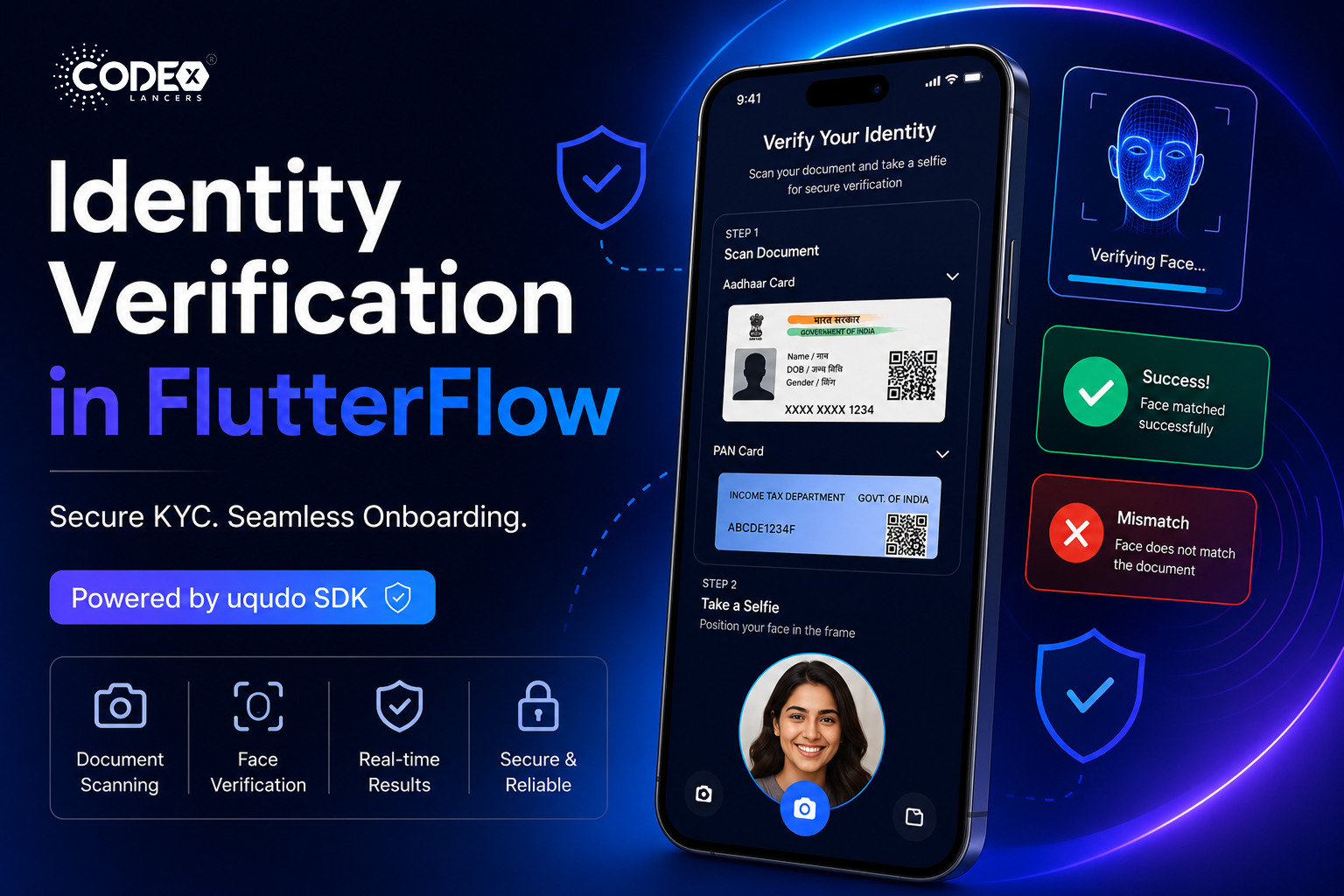
We implemented document scanning for Aadhaar Card and PAN Card. Using uqudo’s document verification capabilities, the app extracts and validates identity data efficiently.
2. Face Capture & Biometric Verification
The device’s front camera captures the user’s face and matches it against the scanned document ensuring authenticity, fraud prevention, and real-time verification.
3. Verification Result Handling
Clear outcomes are displayed directly in the UI face matched successfully or face mismatch detected. This improves transparency and user trust during onboarding.
4. Error Handling & User Feedback
Robust error handling was implemented using Custom Actions to manage invalid document scans, face mismatch scenarios, camera permission issues, and SDK-related errors. Providing clear feedback significantly improved the user experience.
Outcome & Impact
- Successfully implemented a production-ready KYC flow within FlutterFlow.
- Reduced onboarding friction with automation.
- Enabled seamless integration of native SDKs in a low-code environment.
- Improved user trust with real-time verification feedback.
Key Learnings
- FlutterFlow Custom Actions are powerful for integrating complex SDKs.
- Combining low-code UI with custom Flutter logic offers both speed and flexibility.
- Native SDK integration is achievable without compromising maintainability.
- Proper error handling is critical for user trust and retention.
Conclusion
Integrating the uqudo SDK in FlutterFlow using Custom Actions proved to be an effective approach for building a secure and scalable identity verification system. This method bridges the gap between low-code development and advanced native capabilities enabling faster delivery without sacrificing control or performance.
If you’re building a FlutterFlow app that requires KYC, identity verification, or onboarding automation, this approach can significantly reduce development complexity while ensuring a high-quality user experience.